

By Dr. Shana Thomas, DC, chiropractor and owner of Flexx Chiropractic Published October 2026 · Last reviewed October 2026
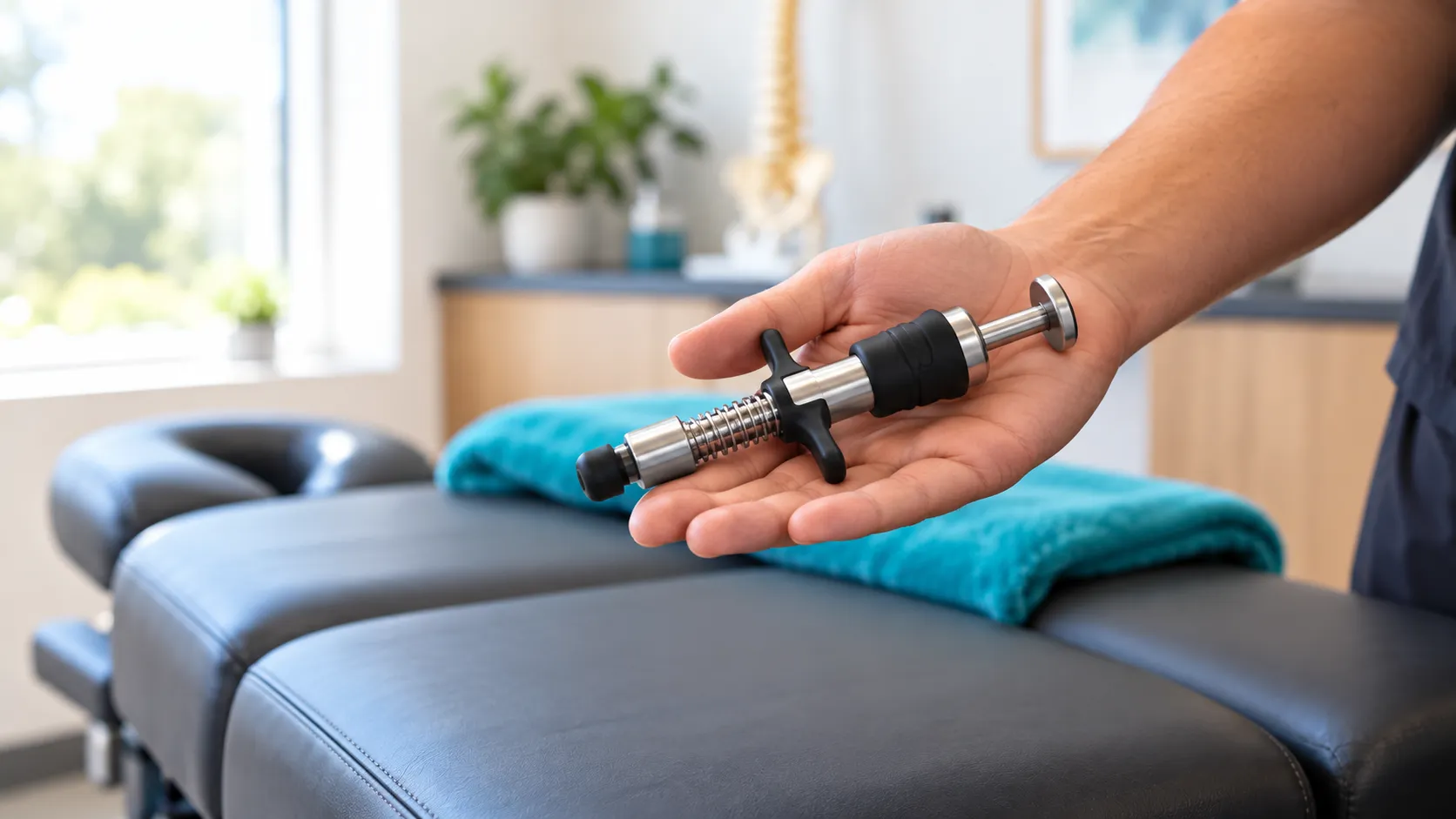
The Activator Method is a chiropractic technique that uses a small, spring-loaded handheld instrument to deliver a quick, gentle pulse to a specific joint. It replaces the hands-on twist or thrust many people picture when they think of chiropractic. Most patients describe it as a firm, fast tap, with no twisting and no "cracking."
If you have been curious about chiropractic care but nervous about being twisted or popped, this is the technique I want you to know about. Here is what it is, what it feels like, who it tends to suit, and how it fits into care at Flexx.
The Activator Method is an instrument-assisted adjusting technique. It was developed in 1967 by chiropractor Dr. Arlan Fuhr, who co-invented the Activator Adjusting Instrument and later founded Activator Methods International in Phoenix, Arizona.
Instead of using their hands to move a joint, the chiropractor places the small tip of the instrument on a precise point and releases a spring-loaded pulse. The pulse is very fast and uses far less force than a typical manual adjustment.
It is still a real chiropractic adjustment. The National Center for Complementary and Integrative Health describes spinal manipulation as a controlled thrust applied to a joint by a practitioner's hands or a device. The Activator is the device.
Here is what a typical Activator adjustment looks like at Flexx, step by step.
You lie face down, fully clothed, on a padded treatment table. There is no need to change into a gown.
I check how your body is responding. Activator protocols use simple tests, such as comparing your leg lengths while you lie face down and while you make small movements, to help pinpoint which areas need attention.
I place the instrument on a specific spot. You will feel the small rubber tip rest against your back, neck, or another joint.
You hear a click and feel a quick tap. The click is the instrument, not your joint. The tap is fast, over almost before you notice it.
We recheck and repeat as needed. Each area takes only a few seconds.
What you won't feel: your head being turned and thrust, your body being twisted on the table, or the joint "pop" you may have seen in videos. Many of my patients say the anticipation was worse than the adjustment itself.
Afterward, some people feel mild soreness or stiffness, similar to the day after starting a new exercise. According to NCCIH's summary of spinal manipulation for low-back pain, these side effects are usually mild and tend to go away within 24 hours.
Both approaches aim to improve how a joint moves. The main differences are how the force is delivered and how it feels.
What does the research say? A 2012 systematic review in the Journal of the Canadian Chiropractic Association examined eight studies and found the Activator instrument provided clinically meaningful benefits comparable to manual manipulation for certain types of spinal pain and jaw (TMJ) dysfunction. The research base is small, and more high-quality studies are needed, so I'm careful not to oversell it. What the evidence does support is that low-force, instrument-assisted adjusting is a reasonable option, not a lesser one.
An honest note on expectations. If you are used to hands-on adjustments and love the feeling of the "pop," the Activator will feel different. I would much rather you know that before your first visit than be surprised on the table. Ask me about it at your consultation, and I will walk you through exactly what to expect.
In my experience, the Activator Method tends to suit people who:
Feel anxious about chiropractic because of the twisting or cracking
Want neck adjustments without having their head rotated (see our neck pain care in Columbus)
Prefer a gentler approach, including many older adults and people with arthritis
Are dealing with back pain and want to start conservatively (see our back pain treatment page)
Have jaw or TMJ discomfort alongside neck tension (see headache, migraine, and TMJ care)
Whether it is right for you depends on your exam. Low force does not mean "right for every condition," and part of my job is telling you when chiropractic care is not the best next step.
Chiropractic care is generally considered safe when performed by a licensed chiropractor, and serious complications are rare. That is true for low-force techniques too. Mild, short-lived soreness is the most common side effect.
Your health history still matters. Before any adjustment, we ask about past injuries, surgeries, medications, bone density, and other conditions, because some health problems can change what is appropriate for you. Please tell us everything, even if it seems unrelated.
Some symptoms need medical care before chiropractic care. Contact a medical doctor or call 911 if you have:
Loss of bladder or bowel control, or numbness in the groin or inner thighs
Leg weakness that is getting worse
Back or neck pain after a major fall or car accident
Fever along with back pain, or unexplained weight loss
A sudden, severe headache that feels like the worst of your life
Confusion, vision changes, or other neurological symptoms after a head injury
If anything in your exam points to a problem that needs a medical doctor, we will tell you and help you get there.
An adjustment is one part of a larger plan. At Flexx Chiropractic, care is coordinated by one team.
Your first visit: a consultation with our case manager and a thorough exam. X-rays are taken only when they're needed, and every x-ray is sent to a radiologist to be read.
Your Report of Findings: a second visit, usually within 24 to 48 hours, where we go over your findings, your recommended plan, and your costs, including what your insurance does and does not cover. Our new patient page walks through each step.
Rehab alongside adjustments: our rehab team works with me on strength and mobility so the progress you make on the table holds up in daily life. Learn more about physical rehabilitation at Flexx.
How many visits you will need depends on your exam, your goals, and how you respond. There is no one-size schedule.
I first studied the Activator Method at Sherman College in Spartanburg, South Carolina. It made so much sense to me that I moved to Phoenix to train under one of the technique's developers. After joining a Columbus practice as an associate, I earned an Advanced Proficiency Rating in Activator Methods, and in 2017 I opened Flexx Chiropractic.
What drew me to it then is what keeps me using it now: it lets me be precise without being forceful. For patients who have been hesitant to try chiropractic care, that difference often matters.
If you are curious whether a low-force adjustment could help your back, neck, or joint pain:
Write down your questions. What hurts, when it started, and what you have already tried.
Learn how our first visit works on our chiropractic care page.
Schedule an evaluation so we can see whether the Activator Method is a good fit for you.
Schedule an appointment or call us at 662.327.6586.
Does an Activator adjustment hurt? Most people feel a quick, firm tap that is not painful. Some feel mild soreness afterward that usually fades within a day.
Will I hear my back crack? No. The click you hear comes from the instrument itself, not from your joint.
Is it "actuator" or "Activator" chiropractic? It is the Activator Method. "Actuator" is a common mix-up, but both searches refer to the same low-force, instrument-assisted technique.
Can the Activator be used on the neck? Yes. Many patients choose it specifically because it adjusts the neck without twisting or rotating the head. Whether it is appropriate for you depends on your exam.
This article is for general education and is not medical advice. Results vary, and chiropractic care is not right for every condition. If you have severe, sudden, or worsening symptoms, contact a medical doctor or call 911. An evaluation at Flexx Chiropractic is the best way to learn which options fit your situation.